| |
|
|
|
RESOURCESThe History of Crosses and CrucifixesA note from Rev. Ricky Anderson, owner of Holy Land Treasures USA
This history of Crosses and Crucifixes is posted on Crosses.org but the author is unknown and therefore is posted here without his or her permission. I think that it is very informative.
See all of our Crosses from the Holy Land or our lovely Crucifixes
The cross most commonly referred to and most usually depicted on Christian monuments of all ages is that called the crux immissa (i.e. the vertical trunk extending beyond the transverse beam). It was on a cross such as this that Christ actually died, and not, as some would maintain, on a crux commissa. And this opinion is largely supported by the testimony of the writers we have quoted. The crux immissa is that which is usually known as the Latin cross, in which the transverse beam is usually set two-thirds of the way up the vertical. The Greek cross, adopted by the East and by Russia, has the transverse set half-way up the vertical.
Both the Latin and Greek crosses play an important part in the decorative styles of church buildings during the fourth and subsequent centuries. The church of Santa Croce at Ravenna, is in the form of a Latin cross; and on the pillars of a church built by Bishop Paulinus at Tyre in the fourth century the cross is carved in the Latin way. The facade of the Catholicon at Athens shows a large Latin cross. And this style of cross was adopted by West and East until the schism occurred between the two churches. Indeed, at Constantinople the church of the Apostles, the first church of St. Sophia, consecrated by Constantine, those of the monastery of St. John at Studium, of St. Demetrius at Salonica, of St. Catherine on Mount Sinai, as well as many churches at Athens, are in the form of the Latin cross. Crosses appear in the decorations of capitals, balustrades, and mosaics. In the far-off lands of the Picts, the Bretons, and the Saxons, it was carved on stones and rocks, with elaborate and complex Runic decorations. And even in the Catholicon at Athens, crosses no less lavishly ornamented are to be found.
The cross also played an important part in heraldry and diplomatic science. The former does not directly come within our scope; of the second we shall give the briefest outlines. Crosses are to be found on documents of early medieval times and, being placed at the head of a deed, were equivalent to an invocation of heaven, whether they were plain or ornamental crosses. They were at times placed before signatures, and they have even been equilavalent to signatures in themselves. Indeed, from the tenth century we find, under contracts, rough made crosses that have all the appearance of being intended as signatures. In our own day the cross is reserved as the attestation-mark of illiterate people. A cross was characteristic of the signature of Apostolic notaries, but this was carefully designed, not rapidly written. In the early Middle Ages crosses were decorated with even greater splendor. In the center were to be seen medallions representing the Lamb of God, Christ, or the saints. Such is the case in the Velletri cross and that which Justin II gave to St. Peter's, mentioned above, and again in the silver cross of Agnello at Ravenna. All this kind of decoration displays the substitution of some more or less complete symbol for the figure of Christ on the cross.
Another symbol which has been connected with the cross is the ansated cross (crux ansata) of the ancient Egyptians, wrongly called the "ansated key of the Nile". It often appears as a symbolic sign in the hands of the goddess Sekhet. From the earliest times also it appears among the hieroglyphic signs symbolic of life or of the living, and was transliterated into Greek as Anse (Ansa). But the meaning of this sign is very obscure. We may add that some have claimed to find the cross on Grecian monuments in the letter (chi), which, sometimes in conjunction with (rho), represented on coins the initial letters of the Greek word chrysoun, "gold", or other words indicative of the value of the coin, or the name of the coiner.
In the bronze age we meet in different parts of Europe a more accurate representation of the cross, as conceived in Christian art, and in this shape it was soon widely diffused. This more precise characterization coincides with a corresponding general change in customs and beliefs. The cross is now met with, in various forms, on many objects: fibulas, cinctures, earthenware fragments, and on the bottom of drinking vessels. Some are of the opinion that such use of the sign was not merely ornamental, but rather a symbol of consecration, especially in the case of objects pertaining to burial. In the Etruscan cemetery of Golasecca every tomb has a vase with a cross engraved on it. True crosses of more or less artistic design have been found in Tiryns, in Crete, and on a fibula from Vulci. These pre-Christian figures of the cross have misled many writers to see in them types and symbols of the manner in which Jesus Christ was to expiate our sins. Such inferences are unwarranted, being contrary to the just rules of criticism and to the exact interpretation of ancient monuments.
The Processional Cross
When Bede tells us that St. Augustine of England and his companions came before Ethelbert "carrying a silver cross for a standard" while they said the litanies, he probably touched upon the fundamental idea of the processional cross. Its use seems to have been general in early times and it is so mentioned in the Roman "Ordines" as to suggest that a processional cross belonged to each church. An interesting specimen of the twelfth century still survives in the Cross of Cong, preserved in the museum of the Royal Irish Academy, Dublin. This wooden cross is made of oak covered with copper plates, but much decoration is added in the form of gold filigreework. It lacks most of the shaft, but is two feet six inches high, and one foot six inches across the arms. In the center is a boss of rock crystal, which formerly enshrined a relic of the True Cross, and an inscription tells us that it was made for Turloch O'Conor, King of Ireland (1123). It seems never to have had any figure of Christ (like a Crucifix), but other processional crosses of the 13th and 14th centuries are for the most part true Crucifixes. In a great number of cases the shaft was removable, and the upper portion could be set in a stand to be used as an altar cross. Indeed it seems not impossible that this was the actual origin of the altar cross employed during Mass. Just as the seven candlesticks carried before the pope in Rome were deposited before or behind the altar, and probably developed into the six altar candlesticks with which we are now familiar, so the processional cross seems also to have first been left in a stand near the altar and ultimately to have taken its place upon the altar itself. To this day the ritual books of the Church seem to assume that the handle of the processional cross is detachable, for in the funeral of infants it is laid down that the cross is to be carried without its handle. All Christians are supposed to be the followers of Christ, hence in procession the Crucifix is carried first, with the figure of Christ turned in the direction in which the procession is moving.
In the Russian Church the conventional form in which the cross is usually shown is in fact a 3 barred cross, of which the upper bar represents the title of the cross, the second the arms, and the lowest, which is always inclined at an angle, the foot-rest. In England it may be said that in the early years of Elizabeth's reign a clean sweep was made of the crosses so long venerated by the people. All the roods were ordered to be pulled down, and the crosses were removed from the altars, or rather the communion tables which replaced the altars. The only check in this movement was the fact that the queen herself, for some rather obscure reason, insisted at first on retaining the Crucifix in her own private chapel. The presence of a Crucifix or even a plain cross upon the altar was long held to be illegal in virtue of the "Ornaments Rubrics". In recent years, however, there has been a notable reaction, and crosses, or even Crucifixes, are quite commonly seen upon the altar of Anglican churches. Again, in the reredos recently erected in St. Paul's Cathedral in London a large Crucifix, with the figures of St. Mary and St. John, forms the most conspicuous feature. In Lutheran churches there has always been much tolerance for the Crucifix either upon or behind the altar.
Cross Quotes from the Holy Bible:
"For Christ sent me not to baptize; but to preach the gospel: not in wisdom of speech, lest the cross of Christ should be made void" I Cor., i, 17
"With Christ I am nailed to the cross" Gal., ii, 19
Christ . . . . "might reconcile both to God in one body by the cross" Eph., ii, 16
"For many walk . . . enemies of the cross of Christ" Phil., iii 18
"Blotting out the handwriting of the decree that was against us, which was contrary to us.
And he hath taken the same out of the way, fastening it to the cross" Col., ii, 14
"But God forbid that I should glory, save in the cross of our Lord Jesus Christ; by whom the world is crucified to me, and I to the world". Gal., vi, 14
A Crucifix (from Latin cruci fixus, meaning "one fixed to a cross") is a cross with a representation of Jesus' body, or corpus. It is a principal symbol of the Christian religion, primarily used in the Catholic, Anglican, and Eastern Orthodox Churches. It emphasizes Christ's sacrifice, His death by crucifixion, his subsequent resurrection, and the grace and rebirth that he offers to believers. This history of the Crucifix goes back to the beginning of Christianity, and Christ's death on the cross. However, it was originally seen as a grotesque symbol, a sign of death. It was only over time that the Crucifix, through its many phases, was imbued with the meanings it now holds for Christian believers.
The Crucifix is a reminder of the trials and tribulations that human beings face and the hope that comes from the redemption offered through Christ's death on the cross to those who believe. It is a fusion of art and faith, and has been a consistent symbol of Catholicism for over 1500 years.
Crosses
A cross is a geometrical figure consisting of two lines or bars perpendicular to each other, dividing one or two of the lines in half. The lines usually run vertically and horizontally; if they run diagonally, the design is technically termed a saltire.
The word cross was introduced to English in the 10th century as the term for the instrument of the torturous execution of Christ, ultimately from Latin crux, via Old Irish cros. The word can nowadays refer to the geometrical shape unrelated to its Christian significance. The Latin Crux (translating Greek stauros) was a Roman torture device used for crucifixion.
As emblems and symbols
| Cross Name | Description | Picture |
| Christian cross |
Also known as the Latin cross or crux ordinaria. This cross is the most common symbol of Christianity, intended to represent the death of Jesus when he was crucified on the True Cross and his resurrection in the New Testament.
|
 |
| Looped Tau cross |
Also known as the Key of the Nile, the Looped Tau Cross, and the Ansate Cross. It was an Ancient Egyptian symbol of life and fertility. Sometimes given a Latin name if it appears in specifically Christian contexts, such as the crux ansata ("handled cross").
|
 |
| Coptic ankh |
The Coptic ankh is the Ankh related pre Original Coptic cross of the early Gnostic Christians in Egypt.
|
 |
| Original Coptic Cross |
The original Coptic cross used by early Gnostic Christians in Egypt.
|
 |
| Sun cross |
Also known as the Sunwheel, solar cross or Odin's cross, because Odin's symbol in Norse mythology was a cross in a circle. Used throughout Native American culture to represent the great Medicine Wheel of life. It's also the symbol used by the Gnostic Movements.
|
 |
| High cross |
Free-standing Celtic crosses commonly found in Ireland and to a lesser extent in Great Britain. This cross is very common in churches and graveyards.
|
 |
| Coptic Cross |
The Coptic cross has a small circle from which emanate four arms of equal length, with angled T shapes in the corners, cross pieces outward, representing the nails used in Jesus' crucifixion. This cross receives its name from Coptic Christianity, which centered around Alexandria, Egypt.
|
 |
| Canterbury cross |
Used in the Anglican Churches. This cross has four arms of equal length, each widening at the outer end in a hammer shape so that their rims nearly form a circle. Each arm bears a triangular panel incised with a triquetra symbolizing the Trinity. In the center of the cross is a small square. The Anglo-Saxon original, as a brooch, dates from c. 850 A.D. and was excavated in 1867 in Canterbury, England. A stone replica of the Canterbury crosscan be found in Canterbury Cathedral and in many other Anglican cathedrals around the world. [1]
|
 |
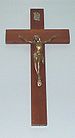
| Crucifix |
A cross with a representation of Jesus' body hanging from it. It is primarily used in the Catholic Church, Anglican churches, and Eastern Orthodox churches, and it emphasizes Christ's sacrifice, his death by crucifixion.
|
 |
| Greek cross |
Used especially by Eastern Orthodoxy and Early Christianity Also known as the crux immissa quadrata. This cross has all arms of equal length. Often the arms curve wider as they go out.
|
 |
| Florian cross |
Adopted as an emblem by the fire service, this cross is named for Saint Florian, the patron saint of Poland, Austria and firefighters. Although similar to the Maltese Cross and Cross pattée, it differs in having arms rounded outwards at the ends. Two different versions are included here. The cross above is commonly found on fire service badges, patches, and emblems. The cross below is typical of the St. Florian medallion or medal.
|

 |
| Eastern cross |
Used in the Eastern Orthodox Church and Eastern Catholic Churches of Byzantine rite. The top line is said to represent the headboard, and the bottom, slanted line represents the footrest, wrenched loose by Jesus' writhing in intense agony. It is raised to the left side, because that was the side of the righteous criminal who said to Jesus: "remember me when you come into your kingdom". This symbolises the victory of good over evil. The letters IC XC found at the end of the main arm of most Eastern Orthodox Crosses are a Christogram, representing the name of Jesus Christ.
|
 |
| St. Brigid's Cross |
This cross is found throughout Ireland. It is told that the cross was made by Brigid, daughter of a pagan king from reeds to be used as an instrument of conversion. However, Brigid's name is derived from Brigit (also spelled Brigid, Brìghde, Brìde, and Bríde), a Celtic Goddess of fire, poetry, and smithcraft, and today the cross is used to protect houses from fire. This is an example of the integration of religious traditions.
|
 |
|
Labarum
(Chrismon)
|
Constantine I's Labarum is also known as a Chrismon, Chi-Rho (from the two Greek letters that make it up) or monogram of the first two letters of the name Christ. Several other forms of Chrismons exist.
|
 |
| Lorraine Cross |
Used in heraldry. It is similar to a patriarchal cross, but usually has one bar near the bottom and one near the top, rather than having both near the top. This cross is part of the heraldic arms of Lorraine in eastern France. It was originally held to be a symbol of Joan of Arc, renowned for her perseverance against foreign invaders of France.
|
 |
| Marian Cross |
Included on the coat of arms of Pope John Paul II, the Marian Cross is a Catholic adaptation of the traditional Latin cross to emphasize Catholic devotion to Mary.
|
 |
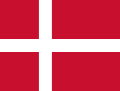
| Nordic Cross |
This cross is used in flags descended from the Dannebrog.
|
 |
| Occitan cross |
Based on the counts of Toulouse's traditional coat of arms, this cross soon became the symbol of Occitania as a whole.
|
 |
| Papal Cross |
The three cross bars represent the Pope's triple role as Bishop of Rome, Patriarch of the West, and successor of St. Peter, Chief of the Apostles.
|
 |
| Patriarchal cross |
Similar to a traditional Christian cross, but with an additional, smaller crossbar above the main one meant to represent all the Orthodox Christian Archbishops and Patriarchs. In the Eastern Orthodox Church, this cross is sometimes seen with an additional, slanted bar near the foot of the cross (see Byzantine Cross). This cross is similar to the Lorraine Cross and the Caravaca Cross.
|
 |
| Presbyterian Cross |
This cross is used by Presbyterian denominations. |
 |
| Red Cross |
This cross is used as a symbol for medical care in most of the world.
|
 |
| Cross of Sacrifice |
A Latin cross with a superimposed sword, blade down. It is a symbol used by the Commonwealth War Graves Commission at the site of many war memorials.
|
 |
| Royal Flag of Georgia |
This cross is used in Georgia as national flag, first used by Georgian King Vakhtang Gorgasali in the 5th century and later adopted by Queen Tamar of Georgia in the 13th century. The flag depicts a Jerusalem cross, adopted during the reign of George V of Georgia who drove out the Mongols from Georgia in 1334.
|
 |
| St. Nino's Cross |
Also known as a "Grapevine cross" and traditionally ascribed to Saint Nino, the 4th-century female baptizer of the Georgians, the St. Nino's cross is used as a symbol of the Georgian Orthodox Church.
|
 |
| St. Thomas Cross |
Also known as a "Mar Thoma Cross" and traditionally ascribed to Saint Thomas,the Apostole of India, it is used as a symbol of the Syro Malabar Catholic Church and venerated by all Saint Thomas Christians denominations.
|
 |
| Saint Andrew's Cross |
Used in Scotland's national flag and the naval ensign of the Russian Navy, the St. Andrew's cross is also called the Saltire, the Boundary Cross (because it was used by the Romans as a barrier) and the crux decussata. Saint Andrew is believed to have suffered a martyr's death on such a cross, hence its name. The cross does not have to be at this particular angle to qualify as a saltire; the symbol X can also be considered a St. Andrew's Cross.
|
 |
| St George's Cross |
This cross is used in England's national flag.
|
 |
| Saint Peter's Cross/Inverted Cross |
An upside-down Latin cross, based on a tradition that holds that Saint Peter was martyred by being crucified upside-down. Today it is often associated with anti-Christian or Satanic groups.
|
 |
| Skull and crossbones |
Not a cross as such, but a saltire made of bones, with an overlaid skull. While traditionally associated with pirates, it was actually relatively rarely used by them, each ship having its own design, often involving an hourglass.
|
 |
| Tau Cross |
Also known as Saint Anthony's Cross, the Egyptian Cross and the crux commissa. It is shaped like the letter T. Francis of Assisi used this cross as his signature.
|
 |
| Thieves' Cross |
Also known as the Furka Cross. The fork, shaped like the letter Y.
|
 |
| Mariner's Cross |
The Mariner's Cross is a stylized cross in the shape of an anchor. The Mariner's Cross is also referred to as St. Clement's Cross in reference to the way he was martyred.
|
 |
| Order of Christ Cross |
This cross was originally used by the Portuguese Order of Christ. Since then it has become a symbol of Portugal, used on the sails of the carracks during the Discoveries Era, and currently by the Madeira Autonomous Region of Portugal and the Portuguese Air Force.
|
 |
| Extreme-right variant of the Celtic Cross |
Some white nationalist and neo-fascist groups adopted this variation of the Celtic cross, made up of simple lines, without any of the ornamental complexity of traditional Celtic crosses. It is thought that this basic variation's minor resemblance to the swastika is the reason it has become popular in such circles.
|
 |
These crosses are ones used primarily or exclusively in heraldry and do not necessarily have any special meanings commonly associated with them. Not all the crosses of heraldry and the crosses with commonly known contexts are listed below.
| Cross name | Description | Picture |
| The cross as heraldic "ordinary" |
A simple heraldic cross (the default if there are no additional specifying words) has arms of roughly equal length, artistically proportioned to the particular shape of the shield, which extend to the edges of the shield. Illustrated is the blazon "Azure, a cross Or" (i.e. a gold cross on a blue shield).
A cross which does not extend to the edges of the shield is humetty, in heraldic terminology.
|
 |
| Cross anchry |
A stylized cross in the shape of an anchor. This is also known as the anchored cross or mariner's cross.
|
 |
| Cross barbée |
Also known as the cross barby or arrow cross, this symbol consists of two double-ended arrows in a cross configuration. Best known today for its use by the fascist Arrow Cross Party in the 1930s, the symbol actually dates to ancient times and was used by Hungarian tribes in the Middle Ages. In Christian use, the ends of this cross resemble the barbs of fish hooks, or fish spears. This alludes to the Ichthys symbol of Christ, and is suggestive of the "fishers of men" theme in the Gospel.
|
 |
| Cross bottony |
A cross with the ends of the arms bottony (or botonny), i.e. shaped like an architectural trefoil. It occurs counterchanged on the flag of Maryland.
|
 |
| Cross cercelée |
A cross which, opening at the ends, turns round both ways, like a ram's horns.
|
 |
| Cross crosslet |
A cross with the ends of each arm crossed.
|
 |
| Cross fleury |
A cross with the ends of the arms fleury, having a shape like a fleur-de-lys.
|
 |
| Cross fourchee |
One form of the heraldic cross fourchee (fourchée, fourchy) or cross fourche (meaning "forked").
|
 |
| Cross fylfot |
This is an upright cross with truncated bent arms.
|
 |
| Jerusalem cross |
Also known as the Crusader's Cross. This cross was the symbol of the Crusader Kingdom of Jerusalem, which existed for almost two hundred years after the First Crusade. The four smaller crosses are said to symbolize either the four books of the Gospel or the four directions in which the Word of Christ spread from Jerusalem. Alternately, all five crosses can symbolize the five wounds of Christ during the Passion. This symbol is also used in the flag of Georgia. It is also the logo for the Knights and Dames of the Holy Sepulcher of Jerusalem as well as the Franciscan order's Custody of the Holy Land. Many retreats including the Ignatian Kairos Retreat, and the Marian L.I.F.E. retreat bestow this cross on its participants as a sign of shared spirituality.
|
 |
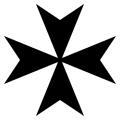
| Maltese cross |
The Maltese cross has arms which narrow towards the center, and are indented at the ends. This is also called an "eight-pointed cross".
|
 |
| Cross moline |
In a cross moline, the ends of the arms are split and curved back.
|
 |
| Cross patonce |
A cross patonce is more or less intermediate between a cross pattée and a cross flory (or fleury).
|
 |
| Cross pattée |
A cross pattee (pattée, patty), or formée (formy) has arms narrowing towards the centre, but with non-indented ends. See also Iron Cross.
|
 |
| Cross pommee |
A cross pommee (pommée, pommy) has a circular knob at the end of each arm.
|
 |
| Cross potent |
This cross has a crossbar at the end of each of its arms. "Potent" is an old word for a crutch, and is used in heraldic terminology to describe a T shape. It is used by many, mostly Roman Catholic, Scouting and Guiding organisations in their logos and insignia.
|
 |
| Quadrate |
A cross with a square at the intersection point.
|
 |
| Cross triple parted and fretted |
In heraldry, a "cross triple parted and fretted" (or "treble parted and fretted") is interlaced. Here, a version which is "Or on an Azure field" (gold on blue) is shown.
|
 |
| Cross voided |
A "cross voided throughout", also known as the Gammadia, can be seen as a Greek cross with its centre lines removed, or as composed of four angles (L shapes) separated by a thin space. So the name "gammadia" refers to its being made up of four shapes similar to a capital Greek letter gamma.
|
 |
| Cross fitchy |
A cross fitchy is a variation where the lower part is fashioned as a sword blade. This can be combined with other variations, e.g. cross crosslet fitchy, shown here. |
 |
| Cross of St James |
The Cross of St. James, similar to a Cross Flory Fitch, is formed by a Cross Flory, where the lower part is fashioned as a sword blade (fitched)—making this a cross of a warrior. It is most frequently depicted in red. (The cross depicted here is the one used by the order of Santiago.)
|
 |
In flags
Several flags have crosses, including all the nations of Scandinavia, whose crosses are known as Scandinavian crosses, and many nations in the Southern Hemisphere, which incorporate the Southern Cross. The Flag of Switzerland since the 17th century has displayed an equilateral cross in a square (the only square flag of a sovereign state apart from the Flag of the Vatican City); the Red Cross emblem was based on the Swiss flag.
Links to our Crosses and Crucifixes categories Wall Crosses Olive Wood Crosses Wall Crucifixes
Large Wall Crucifixes Olive Wood Crucifix Wooden Crucifixes Catholic
The following article is an excellent article written in 1998 by The Rev. Paul McCain of St. Louis, MO. Many Christians take offense at the Crucifix and we feel that the Rev. McCain addresses this subject very well.
On Crucifixes
December 21, 1998
Greetings all,
I was asked a question recently re. the use of the crucifix in Lutheran churches, and decided to compose an answer that might be an “all purpose” response to future questions about the crucifix. The Synod’s Church Information Center is adding it to the “FAQ” they maintain on the WWW site.
Q. Question: Is the use of crucifixes a Roman Catholic practice? Doesn’t the empty cross provide a better symbol for Lutherans? How does the LCMS feel about using a crucifix in church? [Note: A crucifix is a cross with a statue of the crucified Christ on it, also called a Corpus].
A. A common misunderstanding among some some Lutherans is the opinion that a crucifix, or the use of a crucifix, is a “Roman Catholic” practice. The history of Lutheranism demonstrates that the crucifix was a regular and routine feature of Lutheran worship and devotional life during Luther’s lifetime and during the period of Lutheran Orthdoxy. It was also the case among the founding fathers of the Lutheran Church, Missouri Synod. If you were to visit most of the original congregations of the LCMS here in the United States you would find lovely crucifixes adorning their altars, and in addition, beautiful statues on the altar of Christ and the four evangelists, or other such scenes. There is nothing uniquely Roman Catholic about this. Many Lutherans and Lutheran congregations use crucifixes. Crucifixes are used in the chapels of both of our seminaries.
Lutheranism has always considered the crucifix to be a powerful reminder of the sacrifice our Lord Jesus made for us and our salvation, on the cross. A crucifix vividly brings to mind the Apostle Paul’s divinely inspired words, “We preach Christ and Him crucified” (1 Cor. 1:23).
Interestingly enough, while there is certainly nothing “wrong” with an “empty” cross, the practice of using an “empty cross” on a Lutheran congregation’s altar comes more from non-Lutheran sources. At the time of the Reformation there was conflict between Lutherans and Reformed Christians over the proper place of pictures, images, statues and the like in the church. Lutherans stood with historic Christendom in realizing that such art in the church was not wrong, and was a great aid for helping to focus devotional thoughts on the truths of the Word of God, no greater truth can be found that the death of Jesus Christ our Lord for the world’s salvation.
The “empty cross” is not a symbol of Christ’s resurrection, as some say, for the fact is that the cross would have been empty regardless of whether or not Christ had risen from the grave. The point to be kept clear here is that both an “empty cross” and a crucifix, symbolize the same thing: the death of Christ our Lord for the salvation of the world. Many feel that the crucifix symbolizes this truth more clearly and strikingly. That has been the traditional opinion of historic Lutheranism, until the last fifty years ago, due to the influence we will now mention.
Some Lutherans began to move away from crucifixes during the age of Lutheran Pietism, which rejected much of Lutheran doctrine and consequently many Lutheran worship practices. At the time, Lutheran Pietists, contrary to the clear postion of Luther and the earlier Lutherns, held that symbols such as the crucifix were wrong. This was never the view of historic Lutheranism. Here in America, Lutherans have always felt a certain pressure to “fit in” with the Reformed Christianity that predominates much of the Protestant church here. Thus, for some Lutherans this meant doing away with things such as crucifixes, and vestments, and other traditional forms of Lutheran worship and piety. It is sad when some Lutherans are made to feel embarrassed about their Lutheranism by members of churches that teach the Word of God in error and who do not share Lutheanism’s clear confession and practice of the full truth of the Word of God.
Lutheranism has always recognized that the use of any symbol (even the empty cross) can become an idolatrous practice, if in any way people are led to believe there is “power in the cross” or that a picture or representation of a cross has some sort of ability, in itself, to bring us into relationship with Christ and His Gospel. Any of God’s good gifts can be turned against Him in this life and become an end in themselves.
Lutherans have never believed that banning or limiting proper artwork in the church is the way to prevent its improper use. Rather, we believe that proper teaching and right use is the best way, and the way that is in keeping with the gift of freedom we have in Christ to use all things to the glory and honor of God. Thus, many Lutherans use and enjoy the crucifix as a meaningful reminder of our Lord’s suffering and death. It might interest you to know that our Synod’s president has a beautiful crucifix adorning the wall of his office, constantly reminding him and visitors to his office of the great love of God that is ours in Christ Jesus our Lord.
In short, and this is the most important point of all: there is nothing contrary to God’s Holy Word, or our Lutheran Confessions, about the proper use of the crucifix, just as there is nothing wrong with the proper use of an empty cross, or any other church symbol by which we are reminded of the great things God has done for us. We need to guard against quickly dismissing out of hand practices that we believe are “too Roman Catholic” before we more adequately explore their use and history in our own church.
In Christian freedom, we use either the crucifix or an empty cross and should not judge or condemn one another for using either nor not using either symbol of our Lord’s sacrifice for our sins.
********************************************************
|
|
|